
 Gallery
 News
NewsArchaeology and Historical Research
At Kanahastkuanikanist, near Kamestastin, Shustin Rich examines 5000 yr old caribou spear point made of Ramah Chert. Photo: Anthony Jenkinson
(larger version)
(larger version)
The archaeology at Kamestastin gives us a glimpse into the last 8,000 years of life in Nitassinan (Labrador/Northeastern Quebec), from the retreat of the last glaciers to the present day. Working with Innu youth and elders and a team of Smithsonian archaeologists, you will have a chance to learn and discover these histories for yourself.
For more images of the sites and artifacts revealed during the joint research undertaken by Tshikapisk Foundation and the Arctic Studies Center see the archaeology section of the Gallery pages on this website.
For more images of the sites and artifacts revealed during the joint research undertaken by Tshikapisk Foundation and the Arctic Studies Center see the archaeology section of the Gallery pages on this website.
Uashekan Benuen and Makatan (Jonathan Pinette) during September 2005 Archaeology program at Kamestastin. Photo: Stephen Loring
(larger version)
(larger version)
Summer and Fall Archaeology Programs
Each year since 2000 Tshikapisk Foundation has organized Summer or Fall archaeology/ Innu history programs at Kamestastin or in the adjoining region. In September 2005 The Tshikapisk Archaeology program involved a group of Innu youth sponsored by the Sheshatshit Innu Council.
Jordanna Benuen at Kanahastkuanakanist with blade of a large Ramah Chert knife (approx 5000 years old) found by Wayne Broomfield.
(larger version)
(larger version)
The Kamestastin story - 7500 years of human occupation
COMING SOON
Tshikapisk students Uashekan Benuen, Pashin Penunsi, Makatan Jonathan Pinette and the ASC's Stephen Loring screen soil from newly excavated squares at the Tshumushumapeu complex. Photo: Paul Piggot
(larger version)
(larger version)
The Fall 2005 Season - Community Archaeology at Kamestastin
In September Stephen Loring rendezvoused with Innu colleagues from the Tshikapisk Foundation (an Innu experiential education program) and flew into Kamestastin (in Innu-aimun "the place where the wind blows everything off the ground") where he conducted an archaeological training program with a group of Innu youth. The genesis for the research at Kamestastin comes directly from the Innu communities of Sheshatshit and Natuashish, and from the Tshikapisk Foundation. The project combines Loring's long-term research interests in Innu history, archaeology and culture with a research and training program geared to provide training and opportunities for Innu students. The Tshikapisk Foundation, an Innu educational initiative centered in Sheshatshit, is committed to developing the Kamestastin camp as part of an experiential education program aimed at providing land-based Innu culture-centered training and experiences for Innu young people. An applied side of this program seeks to provide employment opportunities for Innu living in the country as research fieldworkers, fishing guides and leaders in adventure tourism initiatives. Integral to the archaeological research at Kamestastin is its commitment to training Innu students in the full-range of cultural resource preservation and management and provide instruction in cultural heritage, geology, and environmental studies that would enable Innu guides to lead subsequent visitors to the region while assuring that cultural and ecological resources were not severely impacted.
Innu archaeological research at Kamestastin began in 1999 and has continued to the present day. Under the co-direction of Anthony Jenkinson (Tshikapisk Foundation, Sheshatshit) and Stephen Loring more then 30 archaeological and historical site localities have been identified in the country surrounding the lake. This fall a brief archaeological reconnaissance and testing program provided documentation on several sites that appear to represent some of the oldest known Maritime Archaic sites in Labrador. As well, the first trace of a paleo-eskimo presence in the interior was documented by Jenkinson who found a Late Dorset stemmed biface on a beach near the outlet of the lake. Made of an unusual banded grey chert that is not at all common on the Labrador coast had us speculating that perhaps the artifact originated in Ungava. Loring has long suspected that there must have been some sort of trading and/or interaction between Middle and Late Dorset and ancestral-Innu groups on the Labrador coast.Perhaps and its all speculation at this point with the arrival of the Inuit in northern-most Labrador and the disruption to former relationships predicated on Ramah Chert procurement may have led to social alignments stretching from the interior of Labrador north to Ungava Bay.
Another exciting aspect of the fall research program at Kamestastin was a brief stint of helicopter support provided by Altius (here a conspicuous note of thanks to Altius president Roland Butler and the head of the Labrador operations, Wayne Broomfield) which enabled us to conduct archaeological surveys to the south of Kamestastin, in the country between Kamestastin and Border Beacon,where Tshikapisk survey teams had previously identified several significant Maritime Archaic sites,and to the north of Kamestastinat Long Pond, an important point on the Innu travel route between Mushuaushipu (the George River) and Emish (Voiseys Bay). At Long Pond we were able to relocate the old Innu camp where, in 1910, William Brooks Cabot photographed the skull of a bear that the Innu had placed in a ceremonial fashion upon a long wooden pole. Recent analysis of the Cabot photograph has led Stephen Loring and Arthur Spiess to make a tentative identification of it as having belonged to a barren ground grizzly bear. Results of this research have been submitted for publication to Arctic and should appear later this year.
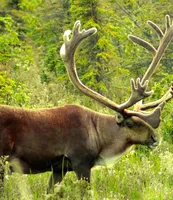
Stephen Loring concluded his summers fieldwork on the 14th September with the arrival, at Kamestastin , of the first phalanx of the George River caribou herd, as over 7000 animals passed by (and sometimes over) the archaeological sites.
Innu archaeological research at Kamestastin began in 1999 and has continued to the present day. Under the co-direction of Anthony Jenkinson (Tshikapisk Foundation, Sheshatshit) and Stephen Loring more then 30 archaeological and historical site localities have been identified in the country surrounding the lake. This fall a brief archaeological reconnaissance and testing program provided documentation on several sites that appear to represent some of the oldest known Maritime Archaic sites in Labrador. As well, the first trace of a paleo-eskimo presence in the interior was documented by Jenkinson who found a Late Dorset stemmed biface on a beach near the outlet of the lake. Made of an unusual banded grey chert that is not at all common on the Labrador coast had us speculating that perhaps the artifact originated in Ungava. Loring has long suspected that there must have been some sort of trading and/or interaction between Middle and Late Dorset and ancestral-Innu groups on the Labrador coast.Perhaps and its all speculation at this point with the arrival of the Inuit in northern-most Labrador and the disruption to former relationships predicated on Ramah Chert procurement may have led to social alignments stretching from the interior of Labrador north to Ungava Bay.
Another exciting aspect of the fall research program at Kamestastin was a brief stint of helicopter support provided by Altius (here a conspicuous note of thanks to Altius president Roland Butler and the head of the Labrador operations, Wayne Broomfield) which enabled us to conduct archaeological surveys to the south of Kamestastin, in the country between Kamestastin and Border Beacon,where Tshikapisk survey teams had previously identified several significant Maritime Archaic sites,and to the north of Kamestastinat Long Pond, an important point on the Innu travel route between Mushuaushipu (the George River) and Emish (Voiseys Bay). At Long Pond we were able to relocate the old Innu camp where, in 1910, William Brooks Cabot photographed the skull of a bear that the Innu had placed in a ceremonial fashion upon a long wooden pole. Recent analysis of the Cabot photograph has led Stephen Loring and Arthur Spiess to make a tentative identification of it as having belonged to a barren ground grizzly bear. Results of this research have been submitted for publication to Arctic and should appear later this year.
Stephen Loring concluded his summers fieldwork on the 14th September with the arrival, at Kamestastin , of the first phalanx of the George River caribou herd, as over 7000 animals passed by (and sometimes over) the archaeological sites.
