
 Gallery
 News
NewsResearch and Learning
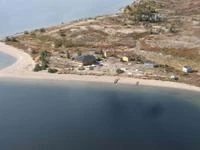
Tshikapisk's Kamestastin camp as it appeared in the fall of 2005. Photo: Nikeshant Andrew
(larger version)
(larger version)
Kamestastin: an ideal location for scientific research and teaching
Tshikapisk's Kamestastin Center is an ideal location for those involved in environmental research and the study of arctic and sub-arctic ecology. The 7500 year old human history of Kamestastin is intimately connected to the story of the great herds of caribou of the peninsula that have shared the land with humans since deglaciation. It can truthfully be said that the modern landscape of this region is defined by the presence of caribou. Countless caribou paths thread themselves over the region and where the myriad paths converge at the ancient river and lake crossings they are sometimes carved deeply into the land. Tshikapisk's lodge is situated at one of these notable water crossings where for milennia the Innu have intercepted the caribou on their fall and spring migrations.The richness of the archaeological record around the Kamestastin crossing is a testament to the antiquity and depth of the relationship between the Innu and the caribou.
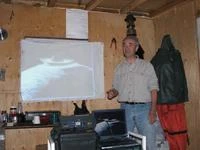
Professor Derek Wilton of Memorial University's Geology department lectures Tshikapisk students and guests on the Kamestastin Impact Crater - September 2005. Photo: Wayne Broomfield, Altius
(larger version)
(larger version)
Geomorphology -The study of the processes which formed the remarkable landscape at Kamestastin.
Kamestastin's geological history and, in particular its origins as a complex meteor impact crater heavily scoured by the glaciers of the last north american ice age (whose final hold out in continental North America was in the Kamestastin region) makes it a remarkable living classroom for those studying or learning about the processes by which the land has been formed and changed over eons of time.
Research initiatives under development between Tshikapisk Foundation and associated agencies and institutional partners.
A.R.I.S: Collaborative Programme of Action Research for Innu Sustainable Development (ARIS)
Summary
This concept note is for a collaborative programme of action research between the Tshikapisk Foundation and the University of Essex in the Innu homeland of Nitassinan in Labrador-Quebec, Canada. The indigenous Innu are nomadic hunters who are known to have continuously inhabited the region for at least 7000 years.
Recent patterns of modern economic and social development promoted since the mid 1960s centred on the export of local natural resources, sedentarisation of households in new settlements, and integration of Innu with mainstream Canadian society. But this approach has brought many social and psychological problems. Some now threaten whole communities, with some of the worlds highest rates of solvent and drug abuse, and suicide. Local knowledge of natural resources and livelihoods is rapidly being lost, and alienation within communities grows.
The Tshikapisk Foundation was established by the Innu to promote coherent self-reliance and personal initiative. In collaboration with the University of Essexs Centres for American Studies and Environment and Society, it proposes a programme of Action Research for Innu Sustainable Development (ARIS) to emphasise the opportunities for economically and culturally sustainable development for the region.
The programme has two main components:
i. Ecological and cultural literacy for the Innu youth;
ii. Ecotourism and ecostudy to raise revenue and increase the national and international profile of the Innu.
Background to the Innu of Labrador-Quebec
The Innu are the indigenous people of the Labrador-Quebec peninsula in Canada who are known to have continuously occupied the region for at least 7000 years. Until the 1960s, they were nomadic hunters, with relatively autonomous and self-reliant livelihoods. The Labrador Ungava peninsula is today home to the largest caribou herd in the world, the so-called George River Caribou. Other species of wildlife live in what is one of the last great wild places in North America, and include black bear, moose, wolves, foxes, lynx, marten and abundant waterfowl. Up to this point, the peninsulas 380,000 square kilometers have been protected by the extreme inaccessibility by road or by ship.
However, their way of life changed dramatically when, at the promptings of the Canadian government and Roman Catholic missionaries, they were settled in two new government-built villages of Sheshatshiu and Utshimassits (Davis Inlet). The official aim was "to civilize them...so that they may take their proper place in our society" (Walter Rockwood, Director of the Division of Northern Labrador Affairs, 1957).
The government sponsored sedentarization of the Innu occurred in the 1950s and 1960s with the last Innu moving from tents into houses at another new settlement, Pukuatshipit, in the winter of 1971-72. This process, in which the most powerful element was the introduction of compulsory schooling on an industrialized society model, disrupted the Innu hunting life and abruptly stopped the transmission of Innu knowledge and values to the post-settlement generation.
Since this sedentarization, Innu society has descended into dependency and declining self-esteem. They now suffer some of the worlds highest rates of suicide, alcohol abuse, solvent abuse and sexual abuse. Both international and Canadian human rights reports have drawn attention to the appalling conditions of life in the Innu villages, the continual requisition of Innu land, and the failure of the Canadian government to seek the consent of the Innu in settling them in villages in the first place.
By almost all accounts of the Innu themselves and outside researchers, the self-destructive tragedies are intimately related to a loss of autonomy, the erosion of their culture, and the gradual disconnection of the Innu people from their land. Concomitantly, the self-confidence of the Innu has been undermined by the vigorous (and ongoing) campaign of assimilation conducted by missionaries, teachers and the Provincial and Federal governments since the 1960s.
Economic and Cultural Development Options for the Innu
There are still Innu alive today who remember subsisting entirely by hunting without outside aid of any kind, where money was unknown and where they never saw an outsider in the interior and only the occasional trader on the coast. Today the reality is that almost all Innu require some sort of monetary income. Virtually the only sources of monetary income are Canadian government welfare programs or jobs in the administrative structures of government, most of which exist locally to administer to the social problems which settlement has produced.
Increasingly the Innu are being pressured into entirely abandoning their hunting life and the land which supports it, and to substitute wage labour in a future economy to be based on industries such as mining and pulpwood logging. Two recent major mineral discoveries (one of Nickel and Copper near the Innu village of Utshimassits and the other of Copper, Northwest of Sept Iles) have increased the pressure on the Innu to abandon their life as hunters.
The dominant pattern of recent modern economic development has been `exogenous centred on outside solutions. The aim of such an approach is to attract external capital, technologies or institutions to local contexts to promote change. Such business recruitment, or `smokestack chasing, can be an important strategy in local development. Yet it is expensive and risky. Incentives usually must offered to encourage businesses to relocate, such as land, infrastructure, tax breaks, and exemptions from labour and environmental regulations. Such incentives can backfire, as they undermine local capacities, resources and self-esteem. All too often, the net effect is simply to move jobs from areas where businesses do not receive subsidies to those where they will.
An alternative school of thought focuses on `endogenous' patterns of development, which implies `growing or originating from within'. The priority is to focus on locally-available natural, social and human assets, and to ask: can anything be done differently that results in more productive use of these available resources? Such development must emerge from local communities and cultures and so reflect the needs of local people.
This alternative or locally-based model for local economies seeks to identify, preserve and improve valuable assets. We conceive of the rural economy as a bucket the local community would like to keep full. However, this bucket invariably has holes in it. Every time someone buys something sourced from outside the economy, then money leaks out. Each time raw materials are exported, then value is added somewhere else. Each time natural resources are depleted or polluted, or cultures are harmed, the local renewable assets base diminishes (Figure 1).
To balance this loss, money must flow in, such as a) when outside people buy local products, such as food, timber, manufactured goods, tourist services, energy and information; b) when local people work outside and bring back or remit salaries; and c) when communities receive pensions or welfare benefits and grants from central or regional governments. Yet such money is in short supply. And even if such an economy is successful at increasing the inflow of resources, then the flows out of the leaking bucket simply increase.
The first priority, therefore, should be to "plug the leaks" in the local economy a restructuring so as to accumulate natural, social and human assets at the same time as achieving the desirable outcomes (Figure 2). Evidence suggests that there five ways to do this, and if these are successful, it then also becomes easier to attract external sources of money, whether it is businesses relocating, consumers buying produce, or tourists visiting.
1. Use local renewable resources rather than externally-sourced ones
Examples of activities that plug the leaks in this way include sustainable agriculture (that emphasises natural resource based technologies rather than those derived from fossil fuels); local food systems and direct marketing; buy local campaigns for businesses; and renewable energy generation (wind, water, tidal and biomass sources).
2. Recycle financial and material resources within the system
Examples of activities that plug the leaks in this way include credit unions and other forms of micro-finance delivery; local currencies and barter systems; community banks and foundations; and waste recycling schemes.
3. Add value to local produce before it is exported or sold
Examples of activities that plug the leaks in this way include local food systems; ecotourism; labelling and accreditation schemes for food, fish and timber production; and local processing and manufacture.
4. Connect up local stakeholders (people and institutions) to create trust, new linkages and more efficient exchanges
Examples of activities that plug the leaks in this way include buy local networks for businesses; participatory and deliberative assessment methods for community planning and regeneration; strengthening of local social institutions; and development of community co-operatives.
5. Build human capital in rural economies
Examples of activities include ecological literacy programmes for both youth and adults, rural field schools, libraries and internet connections.
6. Attract in external resources knowledge, skills, finance and technologies
Examples include ecotourism, scientific visits, and bringing in grants and subsidies.
It is important to note that sustainable development for local economies is not a strategy to create autarkic communities that are only self-sufficient and totally unconnected to the rest of the world. Rather, it is first to make the best use of available resources, and then to engage and trade with other economies from a position of greater strength and self-esteem. As well as bringing economic benefits by reducing leakages, this approach also brings other benefits for sustainable development. It cuts transport costs. It reduces the environmental impacts of transport of goods and services. It promotes awareness of the use of local resources, and increases understanding of production methods and their social and environmental impacts. It strengthens local cultures and knowledge of the land.
The Tshikapisk Foundation
The Tshikapisk Foundation was established by a group of concerned Innu hunting families who began to address the growing problem of dependency by promoting collective self-reliance and personal initiative. With a group of international social and natural scientists as board members, the founders of Tshikapisk aimed to help build a new economy that rewarded rather than penalized young Innu for acquiring a proper Innu education. The Foundation began an ecotourism initiative involving small-scale ecological tourism, including fishing, archaeology, and cultural tourism for non-Innu clients, who participate in these activities with Innu families. Ecotourism is conceived as an approach for generating revenue required to support the educational programmes of the Foundation, and to permit it to devise its own path without the relentless pressure to conform to external and non-indigenous norms and procedures.
To date, Tshikapisk has constructed an operating base in the Northern Labrador tundra and is seeking sufficient funds to complete this facility. In August 2001, Tshikapisk began construction of an Innu Cultural Center in the heartland of the Mushuau Innu at Kamestastin (Mistastin Lake). The logs for the building were cut by a team drawn jointly from Davis Inlet and Sheshatshit and hauled by snowmobile across the ice of Kamestastin to the chosen site at the out flow of this large inland lake. Log peeling was done by a crew from Davis Inlet/Utshimassits under the leadership of Shuashim Nui. Most of the log building was completed by a team from Sheshatshit, assisted by volunteers with specific log building and other construction skills recruited by Tshikapisk. In 2002 the roof was shingled, windows installed and two smaller outbuildings were built. Power for the center will be provided by solar panels augmented by two small wind turbines. But the center remains some way away from being completed and operational.
University of Essex
The Centre for American Studies [ADD]. The director is Dr Colin Samson of the Department of Sociology. His books include A Way of Life That Does Not Exist: Canada and the Extinguishment of the Innu (2003), Health Studies: A Critical Multidisciplinary Reader (1999), The Social Construction of Social Policy (1996, coauthored).
The Centre for Environment and Society is a cross-disciplinary research centre that draws on the expertise of internationally-renowned departments and research centres in the university. It is involved in a range of environment and society research activities, including soil health; social learning and participatory governance; sustainable agriculture; localised food systems; local economic development; environmental and social policy; and community-based management of natural resources. The director is Prof Jules Pretty of the Department of Biological Sciences. His books include Guide to a Green Planet (ed, 2002), Agri-Culture: Reconnecting People, Land and Nature (2002), The Living Land (1998), Regenerating Agriculture (1995), The Hidden Harvest (1992, co-authored); and `Unwelcome Harvest (1991, co-authored).
Proposals for Action and Research
An emerging body of literature clearly shows that the imposition of the political, religious and cultural institutions of industrialized economies as part of an aggressive attempt to assimilate formerly autonomous peoples has a markedly negative impact on the health and well-being of those peoples who are subject to it. There is thus a clear need to take positive steps to reverse the current decline in Innu health and well-being by pursuing projects designed to foster cultural continuity. This can be achieved as part of wider goals for the protection of the internationally-important biological and physical environment that the Innu inhabit. In this regard, we expect eco-tourist and educational programmes to contribute towards internationally recognised environmental goals of sustainable development, and the maintenance and protection of traditional ecological knowledge, which are so valuable to the preservation of ecosystems of the sub-Arctic.
Our proposal seeks to combine the expertise of social and natural scientists with that of Innu hunting families to develop both the eco-tourist and educational objectives of Tshikapisk. Our aim is to embark on a programme of action research with two core elements:
1. The implementation of an Ecological and Cultural Literacy programme within an Innu educational curriculum in the interior of Labrador for vulnerable Innu youth aged between 11 and 16. The programme curriculum established by the Tshikapisk Foundation will enable Innu children to learn or enhance their knowledge of Innu camp life, history, technologies, hunting practices, language, and religion at first hand.
2. The support of an Ecotourism and Ecostudy project at Kamestastin Lake to generate funds for the continuation of Innu cultural activities, sustainable development and international support for the Innu. This will include activities designed to stimulate business and revenue-raising development. Development of international support through archaeological and biological field visits of students from universities in the USA and UK.
Summary
This concept note is for a collaborative programme of action research between the Tshikapisk Foundation and the University of Essex in the Innu homeland of Nitassinan in Labrador-Quebec, Canada. The indigenous Innu are nomadic hunters who are known to have continuously inhabited the region for at least 7000 years.
Recent patterns of modern economic and social development promoted since the mid 1960s centred on the export of local natural resources, sedentarisation of households in new settlements, and integration of Innu with mainstream Canadian society. But this approach has brought many social and psychological problems. Some now threaten whole communities, with some of the worlds highest rates of solvent and drug abuse, and suicide. Local knowledge of natural resources and livelihoods is rapidly being lost, and alienation within communities grows.
The Tshikapisk Foundation was established by the Innu to promote coherent self-reliance and personal initiative. In collaboration with the University of Essexs Centres for American Studies and Environment and Society, it proposes a programme of Action Research for Innu Sustainable Development (ARIS) to emphasise the opportunities for economically and culturally sustainable development for the region.
The programme has two main components:
i. Ecological and cultural literacy for the Innu youth;
ii. Ecotourism and ecostudy to raise revenue and increase the national and international profile of the Innu.
Background to the Innu of Labrador-Quebec
The Innu are the indigenous people of the Labrador-Quebec peninsula in Canada who are known to have continuously occupied the region for at least 7000 years. Until the 1960s, they were nomadic hunters, with relatively autonomous and self-reliant livelihoods. The Labrador Ungava peninsula is today home to the largest caribou herd in the world, the so-called George River Caribou. Other species of wildlife live in what is one of the last great wild places in North America, and include black bear, moose, wolves, foxes, lynx, marten and abundant waterfowl. Up to this point, the peninsulas 380,000 square kilometers have been protected by the extreme inaccessibility by road or by ship.
However, their way of life changed dramatically when, at the promptings of the Canadian government and Roman Catholic missionaries, they were settled in two new government-built villages of Sheshatshiu and Utshimassits (Davis Inlet). The official aim was "to civilize them...so that they may take their proper place in our society" (Walter Rockwood, Director of the Division of Northern Labrador Affairs, 1957).
The government sponsored sedentarization of the Innu occurred in the 1950s and 1960s with the last Innu moving from tents into houses at another new settlement, Pukuatshipit, in the winter of 1971-72. This process, in which the most powerful element was the introduction of compulsory schooling on an industrialized society model, disrupted the Innu hunting life and abruptly stopped the transmission of Innu knowledge and values to the post-settlement generation.
Since this sedentarization, Innu society has descended into dependency and declining self-esteem. They now suffer some of the worlds highest rates of suicide, alcohol abuse, solvent abuse and sexual abuse. Both international and Canadian human rights reports have drawn attention to the appalling conditions of life in the Innu villages, the continual requisition of Innu land, and the failure of the Canadian government to seek the consent of the Innu in settling them in villages in the first place.
By almost all accounts of the Innu themselves and outside researchers, the self-destructive tragedies are intimately related to a loss of autonomy, the erosion of their culture, and the gradual disconnection of the Innu people from their land. Concomitantly, the self-confidence of the Innu has been undermined by the vigorous (and ongoing) campaign of assimilation conducted by missionaries, teachers and the Provincial and Federal governments since the 1960s.
Economic and Cultural Development Options for the Innu
There are still Innu alive today who remember subsisting entirely by hunting without outside aid of any kind, where money was unknown and where they never saw an outsider in the interior and only the occasional trader on the coast. Today the reality is that almost all Innu require some sort of monetary income. Virtually the only sources of monetary income are Canadian government welfare programs or jobs in the administrative structures of government, most of which exist locally to administer to the social problems which settlement has produced.
Increasingly the Innu are being pressured into entirely abandoning their hunting life and the land which supports it, and to substitute wage labour in a future economy to be based on industries such as mining and pulpwood logging. Two recent major mineral discoveries (one of Nickel and Copper near the Innu village of Utshimassits and the other of Copper, Northwest of Sept Iles) have increased the pressure on the Innu to abandon their life as hunters.
The dominant pattern of recent modern economic development has been `exogenous centred on outside solutions. The aim of such an approach is to attract external capital, technologies or institutions to local contexts to promote change. Such business recruitment, or `smokestack chasing, can be an important strategy in local development. Yet it is expensive and risky. Incentives usually must offered to encourage businesses to relocate, such as land, infrastructure, tax breaks, and exemptions from labour and environmental regulations. Such incentives can backfire, as they undermine local capacities, resources and self-esteem. All too often, the net effect is simply to move jobs from areas where businesses do not receive subsidies to those where they will.
An alternative school of thought focuses on `endogenous' patterns of development, which implies `growing or originating from within'. The priority is to focus on locally-available natural, social and human assets, and to ask: can anything be done differently that results in more productive use of these available resources? Such development must emerge from local communities and cultures and so reflect the needs of local people.
This alternative or locally-based model for local economies seeks to identify, preserve and improve valuable assets. We conceive of the rural economy as a bucket the local community would like to keep full. However, this bucket invariably has holes in it. Every time someone buys something sourced from outside the economy, then money leaks out. Each time raw materials are exported, then value is added somewhere else. Each time natural resources are depleted or polluted, or cultures are harmed, the local renewable assets base diminishes (Figure 1).
To balance this loss, money must flow in, such as a) when outside people buy local products, such as food, timber, manufactured goods, tourist services, energy and information; b) when local people work outside and bring back or remit salaries; and c) when communities receive pensions or welfare benefits and grants from central or regional governments. Yet such money is in short supply. And even if such an economy is successful at increasing the inflow of resources, then the flows out of the leaking bucket simply increase.
The first priority, therefore, should be to "plug the leaks" in the local economy a restructuring so as to accumulate natural, social and human assets at the same time as achieving the desirable outcomes (Figure 2). Evidence suggests that there five ways to do this, and if these are successful, it then also becomes easier to attract external sources of money, whether it is businesses relocating, consumers buying produce, or tourists visiting.
1. Use local renewable resources rather than externally-sourced ones
Examples of activities that plug the leaks in this way include sustainable agriculture (that emphasises natural resource based technologies rather than those derived from fossil fuels); local food systems and direct marketing; buy local campaigns for businesses; and renewable energy generation (wind, water, tidal and biomass sources).
2. Recycle financial and material resources within the system
Examples of activities that plug the leaks in this way include credit unions and other forms of micro-finance delivery; local currencies and barter systems; community banks and foundations; and waste recycling schemes.
3. Add value to local produce before it is exported or sold
Examples of activities that plug the leaks in this way include local food systems; ecotourism; labelling and accreditation schemes for food, fish and timber production; and local processing and manufacture.
4. Connect up local stakeholders (people and institutions) to create trust, new linkages and more efficient exchanges
Examples of activities that plug the leaks in this way include buy local networks for businesses; participatory and deliberative assessment methods for community planning and regeneration; strengthening of local social institutions; and development of community co-operatives.
5. Build human capital in rural economies
Examples of activities include ecological literacy programmes for both youth and adults, rural field schools, libraries and internet connections.
6. Attract in external resources knowledge, skills, finance and technologies
Examples include ecotourism, scientific visits, and bringing in grants and subsidies.
It is important to note that sustainable development for local economies is not a strategy to create autarkic communities that are only self-sufficient and totally unconnected to the rest of the world. Rather, it is first to make the best use of available resources, and then to engage and trade with other economies from a position of greater strength and self-esteem. As well as bringing economic benefits by reducing leakages, this approach also brings other benefits for sustainable development. It cuts transport costs. It reduces the environmental impacts of transport of goods and services. It promotes awareness of the use of local resources, and increases understanding of production methods and their social and environmental impacts. It strengthens local cultures and knowledge of the land.
The Tshikapisk Foundation
The Tshikapisk Foundation was established by a group of concerned Innu hunting families who began to address the growing problem of dependency by promoting collective self-reliance and personal initiative. With a group of international social and natural scientists as board members, the founders of Tshikapisk aimed to help build a new economy that rewarded rather than penalized young Innu for acquiring a proper Innu education. The Foundation began an ecotourism initiative involving small-scale ecological tourism, including fishing, archaeology, and cultural tourism for non-Innu clients, who participate in these activities with Innu families. Ecotourism is conceived as an approach for generating revenue required to support the educational programmes of the Foundation, and to permit it to devise its own path without the relentless pressure to conform to external and non-indigenous norms and procedures.
To date, Tshikapisk has constructed an operating base in the Northern Labrador tundra and is seeking sufficient funds to complete this facility. In August 2001, Tshikapisk began construction of an Innu Cultural Center in the heartland of the Mushuau Innu at Kamestastin (Mistastin Lake). The logs for the building were cut by a team drawn jointly from Davis Inlet and Sheshatshit and hauled by snowmobile across the ice of Kamestastin to the chosen site at the out flow of this large inland lake. Log peeling was done by a crew from Davis Inlet/Utshimassits under the leadership of Shuashim Nui. Most of the log building was completed by a team from Sheshatshit, assisted by volunteers with specific log building and other construction skills recruited by Tshikapisk. In 2002 the roof was shingled, windows installed and two smaller outbuildings were built. Power for the center will be provided by solar panels augmented by two small wind turbines. But the center remains some way away from being completed and operational.
University of Essex
The Centre for American Studies [ADD]. The director is Dr Colin Samson of the Department of Sociology. His books include A Way of Life That Does Not Exist: Canada and the Extinguishment of the Innu (2003), Health Studies: A Critical Multidisciplinary Reader (1999), The Social Construction of Social Policy (1996, coauthored).
The Centre for Environment and Society is a cross-disciplinary research centre that draws on the expertise of internationally-renowned departments and research centres in the university. It is involved in a range of environment and society research activities, including soil health; social learning and participatory governance; sustainable agriculture; localised food systems; local economic development; environmental and social policy; and community-based management of natural resources. The director is Prof Jules Pretty of the Department of Biological Sciences. His books include Guide to a Green Planet (ed, 2002), Agri-Culture: Reconnecting People, Land and Nature (2002), The Living Land (1998), Regenerating Agriculture (1995), The Hidden Harvest (1992, co-authored); and `Unwelcome Harvest (1991, co-authored).
Proposals for Action and Research
An emerging body of literature clearly shows that the imposition of the political, religious and cultural institutions of industrialized economies as part of an aggressive attempt to assimilate formerly autonomous peoples has a markedly negative impact on the health and well-being of those peoples who are subject to it. There is thus a clear need to take positive steps to reverse the current decline in Innu health and well-being by pursuing projects designed to foster cultural continuity. This can be achieved as part of wider goals for the protection of the internationally-important biological and physical environment that the Innu inhabit. In this regard, we expect eco-tourist and educational programmes to contribute towards internationally recognised environmental goals of sustainable development, and the maintenance and protection of traditional ecological knowledge, which are so valuable to the preservation of ecosystems of the sub-Arctic.
Our proposal seeks to combine the expertise of social and natural scientists with that of Innu hunting families to develop both the eco-tourist and educational objectives of Tshikapisk. Our aim is to embark on a programme of action research with two core elements:
1. The implementation of an Ecological and Cultural Literacy programme within an Innu educational curriculum in the interior of Labrador for vulnerable Innu youth aged between 11 and 16. The programme curriculum established by the Tshikapisk Foundation will enable Innu children to learn or enhance their knowledge of Innu camp life, history, technologies, hunting practices, language, and religion at first hand.
2. The support of an Ecotourism and Ecostudy project at Kamestastin Lake to generate funds for the continuation of Innu cultural activities, sustainable development and international support for the Innu. This will include activities designed to stimulate business and revenue-raising development. Development of international support through archaeological and biological field visits of students from universities in the USA and UK.
